Be able to explain your business clearly in a few sentences.
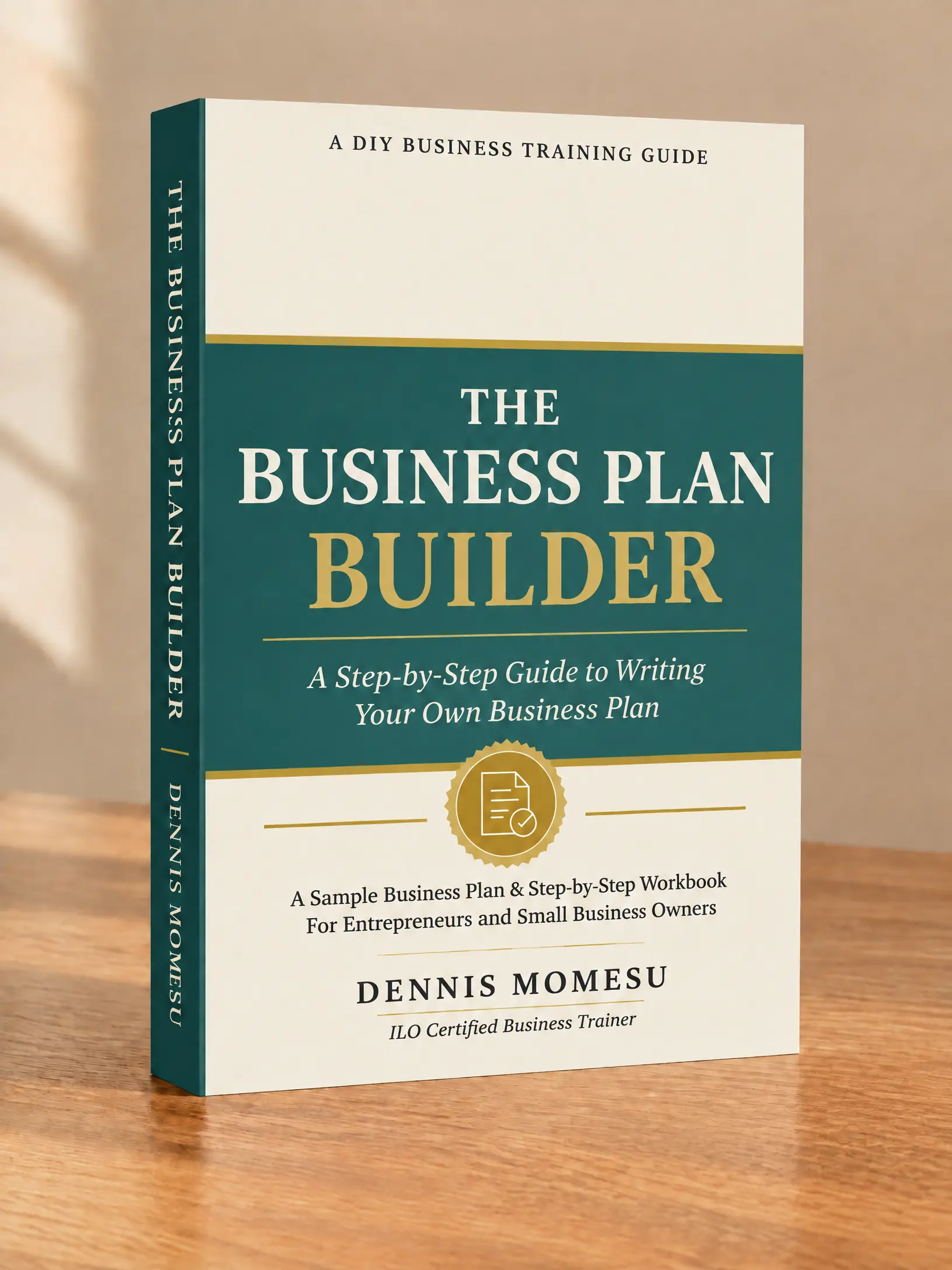
The Business Plan Builder
A Step by Step Guide to Writing Your Own Business Plan
By Dennis Momesu · ILO Certified Business Trainer
A DIY Business Training Guide
Write a Business Plan You Can Actually Use
Even If You Have Never Written One Before
You know your business.
You know what you sell.
You know your customers.
But when someone asks you to put it all into a business plan, you suddenly face a blank page filled with questions you are not sure how to answer.
- Where do you start?
- What numbers should you use?
- How do you estimate sales?
- What does it really cost to run the business?
- How much capital do you need?
- And most importantly, does the business actually make money?
The Business Plan Builder takes you through the process step by step, using plain language, practical examples and worksheets you complete as you go.
Get The Business Plan Builder: Ksh. 879
Ksh. 1,549Save Ksh. 670 Instant PDF download
The Real Problem
Most Business Plans Fail Before The Numbers Begin
Many entrepreneurs think writing a business plan means filling in a template. It doesn't.
A useful business plan starts with understanding your business, your customer, your market and your numbers.
Without this understanding, it is easy to fill a plan with guesses:
- You might overestimate sales.
- You might underestimate costs.
- You might copy a competitor's price without knowing your own costs.
- You might calculate profit without looking at cash flow.
- You might request more funding than the business actually needs.
The problem isn't that you don't know your business. The problem is knowing how to turn what you know into a clear business plan.
You Don't Need More Confusing Corporate Talk. You Need A Clear Process.
The Business Plan Builder gives you one.
Picture This
Imagine Having A Business Plan That Makes Sense To You
Know exactly who your customer is and why they would choose you.
Have a monthly sales estimate you can explain and defend.
Learn the real cost of producing or delivering what you sell.
Understand your contribution margin and break even point.
See the difference between profit and cash.
Work out how much start up capital you actually need.
Trace where the money will come from and how borrowing will affect your cash flow.
Bring all these pieces together into one clear business story.
That's what this workbook is designed to help you do.
What Is Inside The Guide
Build Your Business Plan Step By Step
Inside the Business Plan Builder, you will work through:
Your business idea and what the business actually does
Your target customer and the need you are addressing
Your products or services and how customers will buy
Market research, competitors and gaps in the market
Your marketing approach using product, price, place and promotion
Your monthly sales estimate
The evidence and assumptions behind your sales numbers
The people, roles and skills needed to run the business
Business registration and compliance considerations
Variable costs and fixed or overhead costs
Pricing and contribution margin
Profit and break even analysis
Cash flow
Start up assets and working capital
Contingency planning
Sources of start up capital
Debt repayment and its effect on cash flow
Final consolidation of your complete business plan
You don't have to figure everything out at once. The book takes you through one section at a time.
From Business Idea To Business Plan
A Practical Framework From 01 To 09
01
Understand Your Business
Start with a clear description of what you sell, who you serve, how customers buy and what need your business addresses. Clarity comes before numbers.
02
Understand Your Market
Learn how to research customers, observe competitors, check prices and identify gaps instead of relying on assumptions. Your market research becomes evidence for your decisions.
03
Build Your Sales Estimate
Move from ‘I think I will sell this much’ to a monthly sales estimate based on customers, buying frequency, existing records, competitor observations and other evidence.
04
Plan The Work
Identify the work your business needs and decide who will perform it: Owner, Employee, Family member, Outsourced support. Then calculate the cost.
05
Understand Your Costs
Separate variable costs from fixed and semi variable costs. Calculate the cost of producing or delivering your offer. Then use cost, customer value and competitive conditions to think through your pricing.
06
Test The Numbers
Build your sales, cost and profit plan. Calculate contribution margin. Calculate break even. Then build a separate cash flow plan. Because revenue is not profit. And profit is not cash.
07
Calculate Your Start Up Capital
Work out what you need for equipment, setup, initial stock, wages, rent, utilities and other operating needs. Then add a reasonable contingency based on the uncertainty in your business.
08
Plan Where The Money Comes From
Match your funding sources to your capital requirement. If borrowing is involved, test the repayment against your expected cash flow. Don't borrow more simply because more money is available.
09
Put The Plan Together
Bring everything into one business story. Then run five checks: Market, Sales, Cost, Profit, Cash. If something doesn't work, revise the plan. That's the point of planning.
What Makes This Different
This Isn't A Template You Fill And Forget
The Business Plan Builder is designed to help you think through the business while you write the plan.
Each chapter gives you:
- A clear explanation of the section
- A practical example
- Questions to guide your thinking
- Tables to complete
- Reflection questions
- Action steps
- A clear connection to the next part of the plan
The same sample business, Belavista African Foods, is used throughout the workbook so you can see how the different pieces connect.
You are not given numbers to copy. You are shown where your own numbers should come from.
Built For Entrepreneurs And Small Business Owners
Your Business. Your Numbers. Your Plan.
This guide is useful if you are:
- Starting a new business
- Already running a small business
- Trying to understand whether your business makes money
- Preparing a business plan for financing
- Planning an expansion
- Reviewing your current business model
- Trying to understand your costs and pricing
- Looking for a structured way to think through your business
You don't need to be an accountant. You don't need an MBA. You don't need to know business plan language before you begin.
You need your business information, your willingness to check the numbers and the discipline to work through the questions.
Plus
A One Page Business Plan
After working through the full process, you get a one page summary to bring the key information together.
Business ideaCustomerProblem or needProduct or serviceSales methodCompetitive advantageExpected salesPriceVariable costBreak evenExpected monthly profitStart up capitalFunding sourceMain riskNext action
It gives you a quick view of the business without replacing the full plan.
Your Final Check
Don't Write A Plan To Prove You're Right. Write It To Find Out What Needs To Change.
A business plan is not supposed to make your idea look perfect. It is supposed to help you question the idea before mistakes become expensive.
If one of these checks fails, you don't hide it. You revise the plan. You gather more evidence. You make a better decision.
The final section helps you check:
- Is there evidence customers want the offer?
- Can the business realistically reach the sales forecast?
- Are the major costs known?
- Does the pricing and sales volume leave enough contribution?
- Can the business pay its bills when they fall due?
Start Building Yours
Stop Staring At A Blank Business Plan. Start Building Yours.
You already know more about your business than you think. This guide helps you organise what you know, identify what you still need to find out and turn it into a practical business plan.
No unnecessary confusing corporate talk. No impressive looking guesses. No complicated process. Just a clear step by step approach.
Build Your Plan.
Test Your Numbers.
Get It Right.
Ksh. 1,549Save Ksh. 670 Secure payment · Instant PDF access
Dennis Momesu · ILO Certified Business Trainer
For entrepreneurs and small business owners who want to build clearer, more practical businesses.
M PESAVISAMastercardPayPal